Practical guidance for olive oil mill managers on controlling paste behavior, malaxation time, and separation clarity with harvest-ready enzyme support.
Request pricingIn a busy olive oil mill, malaxation time is often treated like the main lever for yield. Run the paste longer, give the droplets more time to coalesce, and hope the decanter gives back more oil.
Sometimes it works. Sometimes it only slows the line, warms the paste, increases oxidation risk, and creates a scheduling problem when trucks are still arriving at the yard.
The better question is not simply, “How long should we malax?”
It is: what is limiting extractability in this paste, and which operating levers can we control before the bottleneck reaches the decanter?
For mills comparing process aids, choosing the right enzyme supplier for olive oil extraction is not about buying a generic additive. It is about getting a harvest-season tool that helps manage paste structure, release trapped oil, and maintain predictable separation when fruit behavior changes by variety, maturity, and weather.
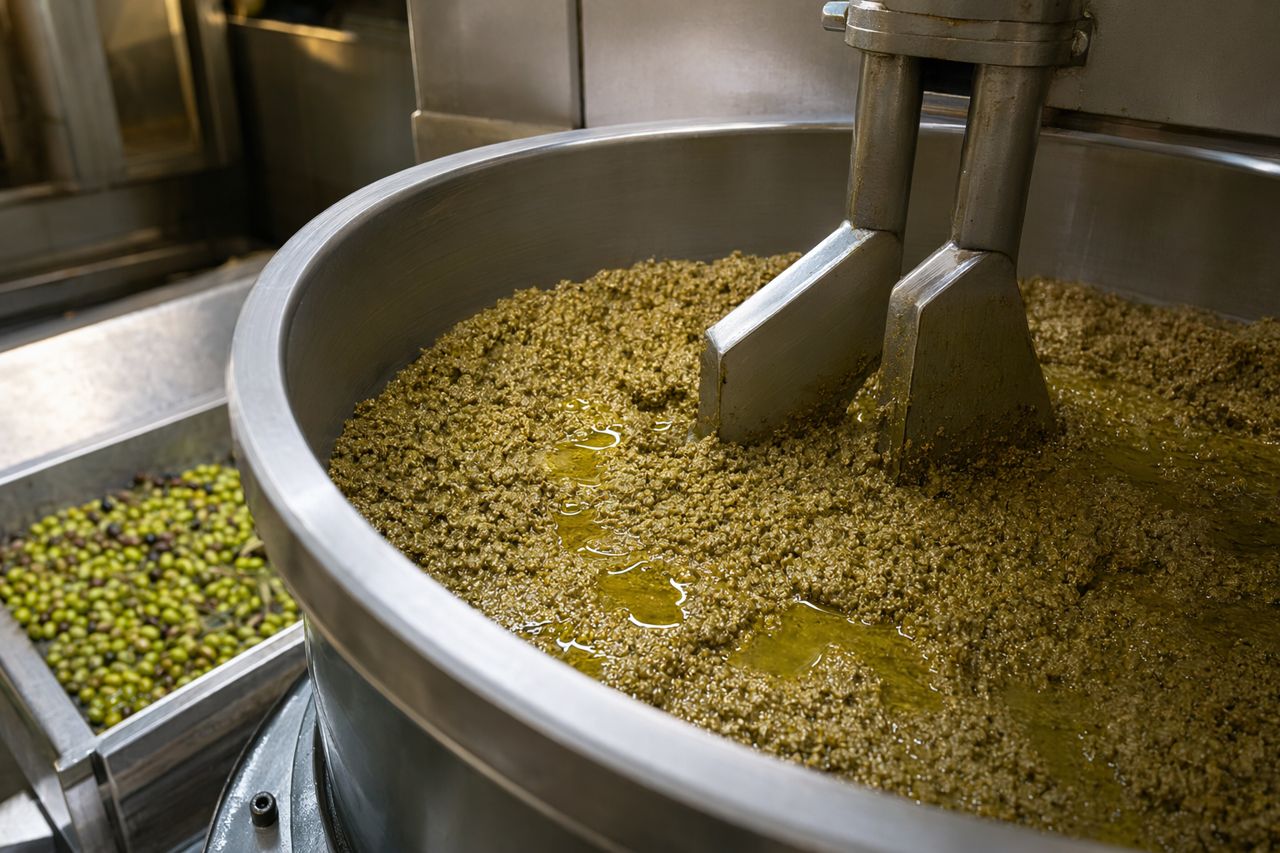
Malaxation supports three important outcomes:
But time alone cannot fully solve a difficult paste. When cell wall structure, natural pectins, high moisture, or soft fruit create a tight emulsion, extending the tank cycle may produce limited gains. The mill loses throughput while the paste remains reluctant to separate.
This is where many mills feel the real operational conflict:
The objective is not maximum time. The objective is controlled extractability at a cycle time the mill can live with.
Extractability is shaped before the paste reaches the decanter. Mill managers can influence it, but only if they read the paste as a process material, not just a batch in a tank.
Early-season olives, rain-affected fruit, frost-stressed fruit, and overripe lots do not behave the same way. Some pastes hold oil tightly. Others create watery separation challenges. Some form stable emulsions that resist clean phase split.
You cannot control the weather or the grove schedule, but you can control how the mill responds:
Crushing defines the starting point for oil release. Too gentle, and oil remains trapped. Too aggressive, and the paste can become harder to manage, with fine solids and emulsion behavior that complicate separation.
A practical mill-floor target is a paste that opens enough cellular structure for release while still feeding the malaxer and decanter consistently.
The paste tells you when it is fighting the process. Operators often see it as:
In these situations, simply adding more time can be an expensive answer. It may occupy tank capacity without addressing the structural reason oil is not releasing cleanly.
Temperature is a powerful lever, but it is not a free lever. Mills need enough process movement for extractability while protecting sensory and commercial quality targets.
When paste structure improves, the mill may have more room to avoid over-relying on temperature as the main extraction lever.
Even a good malaxation target fails when loading varies heavily between tanks or when the line is constantly stopping and starting. Consistent residence time, controlled feed, and stable mixing conditions make every other intervention easier to evaluate.
Enzymequest enzyme solutions are used to help mills manage the biological structure of olive paste. The aim is practical: improve the release of oil held within plant material and support cleaner separation behavior downstream.
For a mill manager, the value is not theoretical. The value appears in the process window:
Enzymes do not replace good milling discipline. They work best when integrated into a controlled process: appropriate crushing, disciplined dosing point, stable malaxation, and operator feedback from paste to decanter.
During harvest, every adjustment has a cost.
If you extend malaxation, you may gain extraction but lose capacity. If you push throughput, you may sacrifice recoverable oil. If you rely too heavily on temperature, you may create quality pressure. If you keep changing decanter settings, you may chase symptoms instead of controlling paste behavior earlier.
A well-selected enzyme program helps shift the decision from reaction to control.
Instead of asking operators to keep stretching the cycle, the mill can evaluate whether paste conditioning improves the extraction window enough to maintain line balance.
That matters most when:
A practical evaluation should focus on mill outcomes, not laboratory language.
Track what your team already cares about:
These observations are often more useful to a mill manager than a complicated technical report during harvest.
An enzyme supplier for olive oil extraction should understand the reality of the mill floor. Harvest does not wait for long qualification cycles, and operators need guidance that fits actual production.
Look for a supplier that can support:
Enzymequest is built for that conversation. We focus on enzyme solutions for olive oil mills that need reliable processing support when fruit, weather, and delivery pressure change by the day.
Different varieties can produce very different paste behavior. A single malaxation habit may leave value behind or reduce line capacity unnecessarily.
By the time the decanter is unstable, the paste condition has already moved downstream. Earlier control in crushing, malaxation, and paste conditioning is usually more effective.
More time can help coalescence, but it cannot always overcome structural resistance in the paste. If the limiting factor is trapped oil within plant material, the mill needs a different lever.
Numbers matter, but so does what operators see: paste texture, oil pooling, phase clarity, feed stability, and cleaning burden. A good evaluation includes both commercial and operational evidence.
Before harvest pressure peaks, define how your mill will make decisions:
The strongest mills do not wait for a bad week to build the plan. They prepare the control strategy before the line is full.
Malaxation time matters, but it is only one part of extractability control. When paste structure is the bottleneck, longer tank cycles may cost more than they return.
For mills under harvest pressure, enzyme support can help widen the operating window: better paste release, more stable separation, and more consistent throughput decisions.
If your team is reviewing enzyme options for the coming season, Enzymequest can help assess your fruit profile, process goals, and trial plan.
Ready to discuss your mill’s extraction challenges? Request a quote through our on-site form and tell us about your harvest window, fruit conditions, and processing goals.
Enzymequest supplies olive oil mills, cooperatives, mill groups and distributors by quote only. Pack format, quantity and delivery timing are quoted per order. Include the product (or the problem to solve), the quantity (trial, season or resale volume) and the destination with your inquiry.
Tell us your application and volume — we reply with pricing and lead time.
We have received your message. We will reply by email.